In defence of Salesforce as a platform that will outlast the model wars
By PS Advisory Team
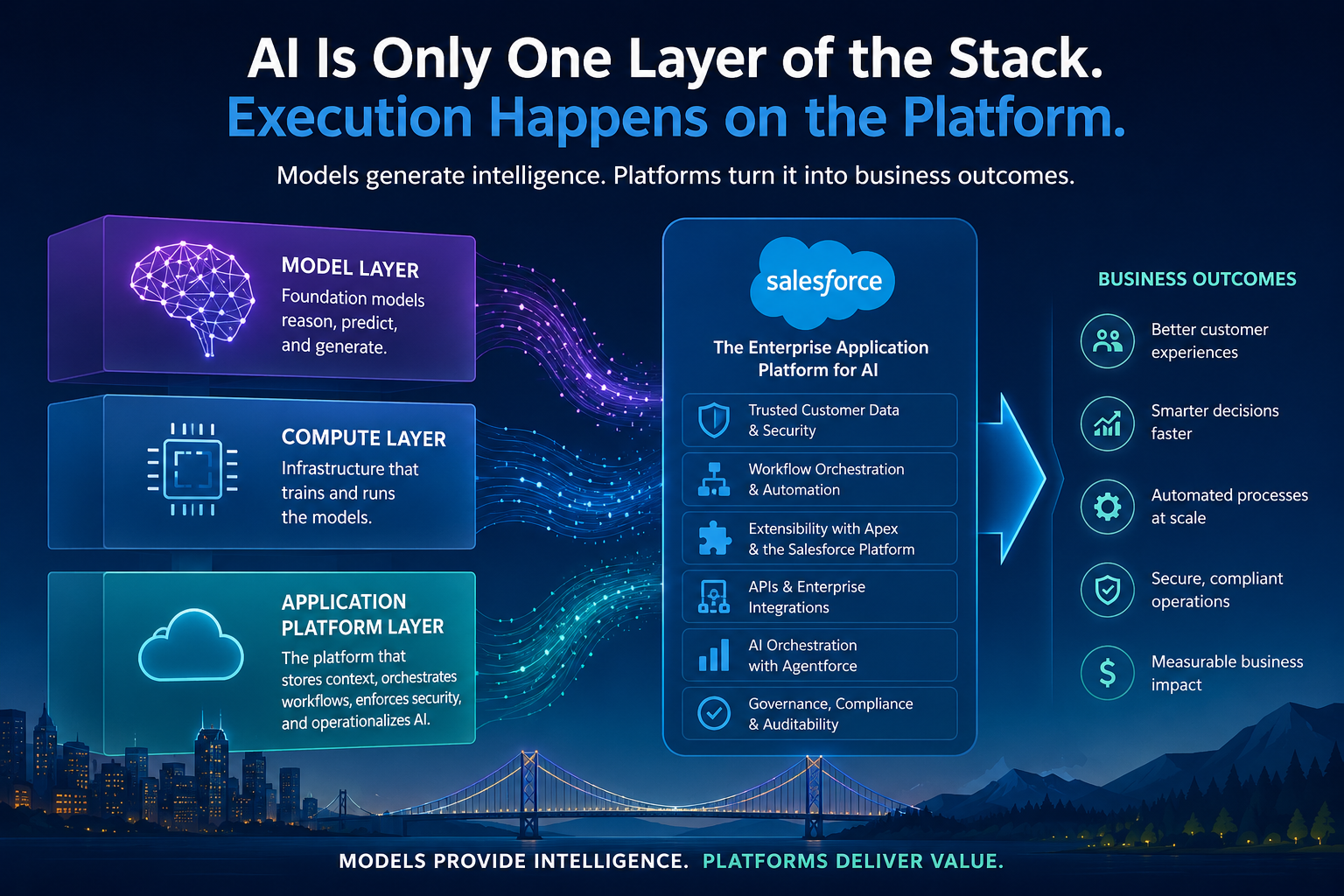
AI Is Only One Layer of the Stack
Over the past two years, nearly every conversation about enterprise technology has become a conversation about AI. Whether it’s Agentforce, Claude, Gemini, Kimi, GPT, or whatever breakthrough model comes next, the focus is almost always on the model itself.
The models are remarkable.
But they’re only one layer of the enterprise AI stack.
When people talk about AI, they often describe three distinct layers:
The compute layer, which provides the infrastructure to train and run models.
The model layer, where foundation models perform reasoning, generate content, and make predictions.
The application layer, where AI is connected to real business processes, enterprise data, security, workflows, and users.
Ironically, it’s the application layer that receives the least attention, despite being where businesses actually create value.
AI Is an Engine, Not a Business Platform
A foundation model is incredibly powerful, but on its own it doesn’t know your customers, your policies, your claims, your opportunities, your contracts, or your business rules.
It needs context.
That context has to come from somewhere.
Likewise, once the model has produced an answer, something still needs to happen. Records need updating. Tasks need creating. Approvals need routing. Customers need notifying. Business rules need enforcing. Audit trails need recording. Permissions need checking. Systems need integrating.
Those responsibilities don’t belong to the model.
They belong to the application platform.
Why the Application Layer Matters
The application layer is where intelligence becomes execution.
It’s responsible for:
Storing trusted business data.
Providing enterprise grade security and governance.
Orchestrating workflows.
Integrating with other enterprise systems.
Executing business logic.
Capturing every interaction for auditing and compliance.
Turning AI outputs into measurable business outcomes.
Without a strong application platform, AI quickly becomes little more than an impressive demonstration.
This Is Where Salesforce Excels
This is why I believe Salesforce deserves to be considered one of the premier application platforms for enterprise AI.
For more than two decades, Salesforce has evolved far beyond being “just a CRM.” It provides an enterprise platform built around secure customer data, declarative automation, workflow orchestration, APIs, integration capabilities, enterprise security, and an exceptionally mature development framework through Apex and the broader Salesforce Platform.
Whether you’re using Agentforce, Claude, Gemini, Kimi, OpenAI, or another model entirely, they all need somewhere to retrieve trusted context and somewhere to execute the results of their reasoning.
Salesforce provides exactly that.
In many ways, AI makes platforms like Salesforce even more valuable than they were before.
AI Models Will Change. Foundations Last.
The reality is that today’s leading model may not be tomorrow’s leading model.
Models will continue to improve. New entrants will emerge. Costs will fall. Capabilities will converge.
What won’t change is every organization’s need for a secure, scalable, governed platform that understands its customers, orchestrates its business processes, and operationalizes AI across the enterprise.
That’s where long term value is created.
Every Organization Will Have Different Needs
None of this suggests Salesforce is the answer to every business problem.
Many organizations rely on industry specific applications that deliver deep functionality for manufacturing, healthcare, finance, engineering, insurance, and countless other domains. Those systems may remain the system of record for specialized operations.
The real question isn’t whether those platforms include AI.
It’s whether they provide the security, governance, extensibility, integration, and operational capabilities required to make AI useful inside your business.
Don’t Let AI Overshadow the Foundation
The excitement surrounding AI has unintentionally cast a shadow over the enterprise platforms that businesses have relied upon for years.
That’s a mistake.
AI is an extraordinary advancement, but it is only one component of a much larger architecture.
The organizations that will win over the next decade won’t simply choose the best model.
They’ll choose the best foundation.
Because in enterprise software, intelligence without execution creates very little value.
The application platform is where intelligence becomes action. And that’s precisely why platforms like Salesforce remain more relevant than ever.